What exactly are wildflowers?
Wildflowers are flowers that can grow without much care. They are adapted to their surroundings and often turn up in meadows, at field edges, along paths or in naturalistic gardens.
The difference from classic ornamental flowers is easy to explain. Ornamental flowers are often bred for particular traits. They are meant to be especially large, especially colourful or especially long-lasting. That looks lovely, but it isn't always helpful for insects. Heavily double flowers in particular often have little pollen and nectar, or it is hard to reach. For bees, bumblebees and other insects, single flowers are therefore usually more valuable.
That doesn't mean every ornamental flower is bad. It just means you should look a little more closely. If you want to do something for insects, single-flowered, native and varied plants are usually the better choice.
Well-known meadow flowers in Germany
Ox-eye daisy
Classic summer meadow
White petals, a yellow centre, long stems. It likes a sunny spot and looks exactly like the picture many people have of a summer meadow. It also looks lovely in natural bouquets and brings a meadow-like touch to a Bouquet.
Poppy
A splash of red
You recognise the poppy at once by its red blooms. The individual flowers often don't last very long, but new ones keep coming. In a vase the poppy is rather delicate, but in a meadow it is a wonderful splash of colour.
Cornflower
A blue that has become rare
The cornflower stands out with its intense blue. It used to be seen far more often in fields. Today you find it less often, partly because farming has changed so much. In bouquets it looks especially beautiful, as true blue is quite rare among flowers.
Yarrow
Hardy and understated
Yarrow is rather understated, but very hardy. It has small white or slightly pink flowers and often grows where other plants struggle. In bouquets it adds a natural, slightly wilder structure.
Meadow sage
Violet for insects
Meadow sage has striking violet to blue flowers. It is valuable to many insects because its blooms offer pollen and nectar. Visually it suits summery bouquets, especially combined with grasses and paler flowers.
Wild carrot
Almost like lace
You recognise wild carrot by its fine white umbels. It looks almost like lace and is especially lovely in natural bouquets. It makes a bouquet instantly airier and less formal.
Field scabious
Purple movement
Field scabious has purple to pink flowers and is much loved by insects. It looks delicate, but not twee. It suits wildflower-style bouquets very well, because it brings a natural sense of movement to the Bouquet.
Bellflower
Delicate and summery
Bellflowers come in various species. Many of them have violet to blue flowers and look very delicate. They suit naturalistic gardens particularly well and give bouquets a light, summery feel too.
Why wildflowers matter to bees
When people talk about bees, many first think of honeybees. But wild bees are extremely important for nature too.
According to the German Federal Agency for Nature Conservation, there are around 600 wild bee species in Germany. More than half of them are already on the Red List. That shows this isn't just a pleasant garden topic, but a matter of real biodiversity.
Many wild bees need particular plants, open soil or suitable nesting sites. When meadows disappear and land becomes ever more uniform, they lose food and habitat. Wildflowers can help here. Not on their own, but as an important part of the solution.
Which flowers are especially bee-friendly?
Bee-friendly plants are above all those with single flowers, where pollen and nectar are easy to reach.
Cornflower
Ox-eye daisy
Meadow sage
Bellflower
Wild carrot
Yarrow
Clover
Field scabious
Scabious
Viper's bugloss
Wildflowers in the garden or on the balcony
You don't need a huge garden to do something for wildflowers. Even a small balcony can work.
The only thing to watch is not to buy just any colourful seed mix. Many mixes look lovely, but contain plants that don't necessarily suit the region. Regional seed is better. For native seed of herbaceous species, the Federal Agency for Nature Conservation divides Germany into 22 regions of origin. This is meant to ensure that the plants suit the region they are grown in.
To begin with, a few pots or a small bed of native species is enough.
When do you sow wildflowers?
That depends on the mix. Many wildflowers can be sown in spring, while others are also suited to late summer or autumn.
Preparation usually matters more than perfect timing. The soil shouldn't be too heavily fertilised. On very nutrient-rich ground, grasses take over faster than the flowers. You also need a little patience. A wildflower patch won't look perfect after two weeks. Some species take longer to really show.
Wildflowers as a bouquet
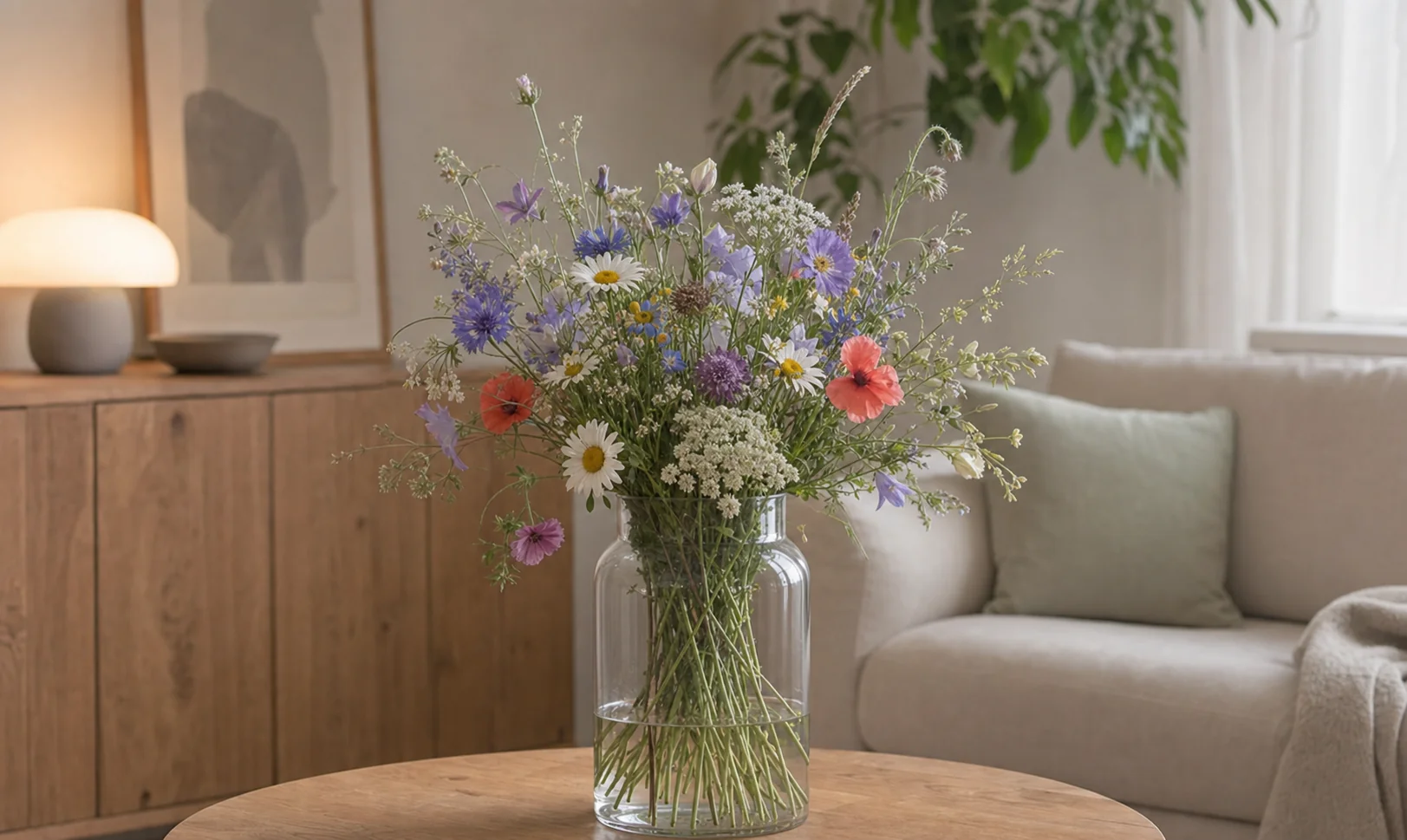
A wildflower bouquet looks different from a classic bouquet. It is looser, more irregular and often looks a little as if you had brought summer home straight from the meadow. That is exactly what makes it beautiful.
Not every wildflower suits a vase equally well. Some last only briefly, others much longer. Ox-eye daisies, cornflowers, yarrow, wild carrot, vetch, lavender or individual grasses can look very lovely in a bouquet.
But it is also important to know that a good wildflower bouquet doesn't have to be made only of true wildflowers. The look often comes from a mix of seasonal cut flowers, loose meadow flowers, grasses and finer filler flowers. That keeps the bouquet natural, but makes it last better.
The wildflower look instead of perfect standard stock
Many classic online bouquets feel very planned. The same shape, the same varieties, the same effect. A wildflower-style bouquet works differently. It thrives on not everything being perfectly even. Some stems stand taller, some blooms look finer, and grasses add movement.
That is exactly why this look suits seasonal bouquets so well. You don't just get some fixed mix, but whatever is looking lovely and works together right now. Local florists tie your bouquet on the day of delivery. If you would like a natural, loose look, you can simply say so when you order.
How do you make a wildflower bouquet last longer?
Wildflower-style bouquets look light, but they still need care. The key points are simple.
Cut the stems fresh
Remove any leaves that would sit in the water
Use a clean vase
Change the water regularly
Keep out of direct sunlight
Don't put them next to fruit
You can find more in our article Keeping cut flowers fresh for longer.
In short
Wildflowers are much more than small flowers by the wayside. They tell us something about the season, about our landscape and about the nature right on our doorstep. If you look more closely, you quickly notice how many different species can grow in a simple meadow.
And perhaps that is the lovely thing about them. Wildflowers don't have to be perfect. They don't have to look arranged. They are simply there, making summer lovelier.
If you would like this natural look at home too, you can order a wildflower-style bouquet from posyco. Just write in the wish field that you would like a loose, natural or meadow-like bouquet. Or start a flower subscription straight away if you would like seasonal bouquets regularly.