What birth flowers are and where the tradition comes from
The idea of assigning a flower to each month is an old one. The Romans already celebrated birthdays with flowers from the relevant month. The modern birth flower canon was shaped by Victorian England in the 19th century, when the language of flowers was a whole etiquette. Who gave whom which flower often said more than any words.
To this day the list follows that tradition. It is not strict botany, some months have two flowers and individual varieties differ depending on the source. But the core has stayed stable for over 150 years: every month has its own bloom. If you are interested in the meaning of individual colours and varieties, you will find more in our article on flowers and their meanings.
Birth flower
Based on your birth month, so on the calendar date from January to December.
Star sign flower
Based on your zodiac sign, for example Cancer from 22 June to 22 July.
Birthstone
A gemstone by month, such as garnet in January or amethyst in February.
The three can overlap, but each is its own tradition.
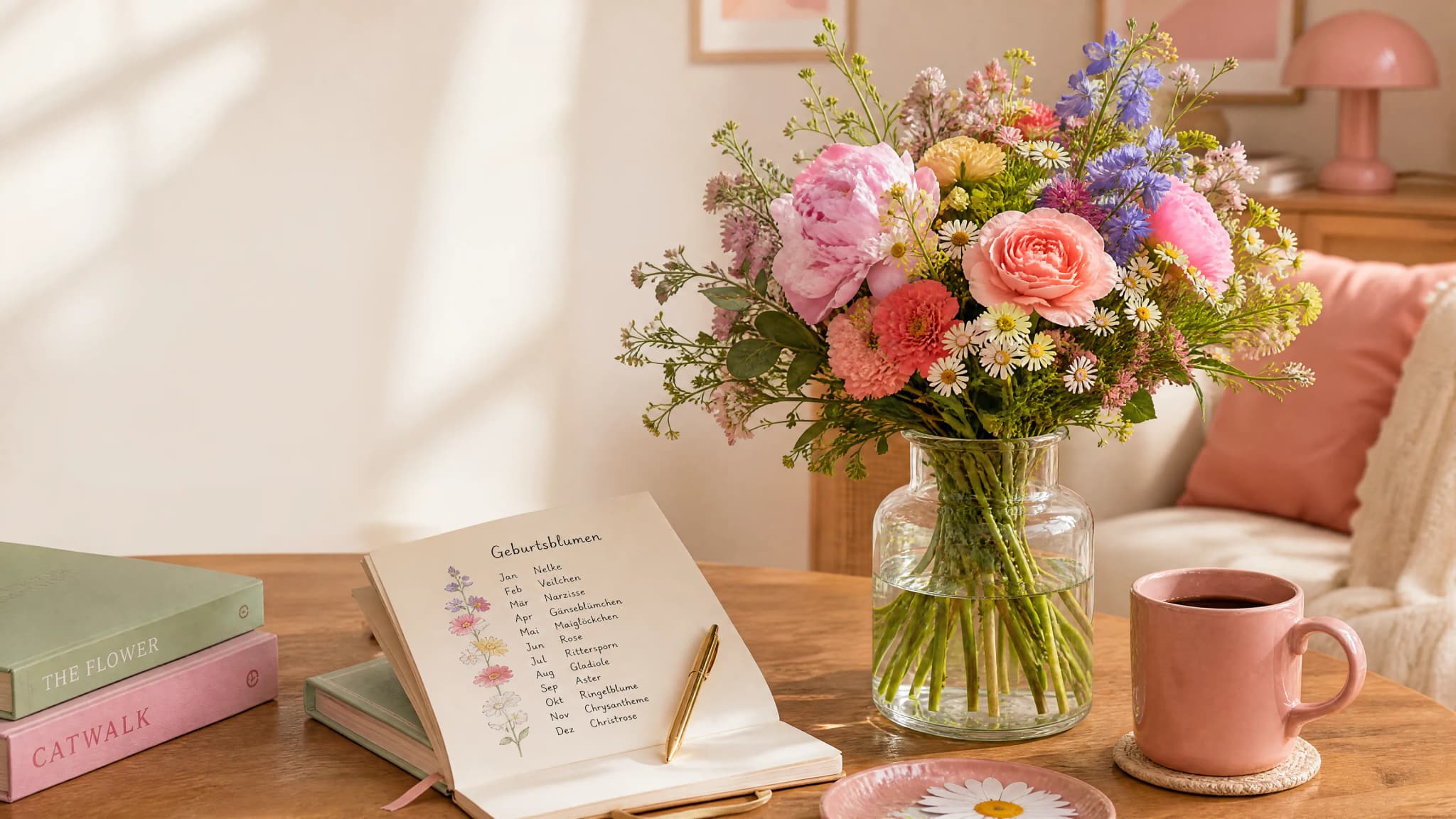
Birth flowers at a glance
| Month | Birth flower | Secondary flower | Meaning |
|---|---|---|---|
| January | Carnation | Snowdrop | Devotion |
| February | Violet | Iris | Loyalty |
| March | Daffodil | Jonquil | New beginnings |
| April | Daisy | Sweet pea | Innocence |
| May | Lily of the valley | Hawthorn | Happiness |
| June | Rose | Honeysuckle | Love |
| July | Delphinium | Water lily | Lightness |
| August | Gladiolus | Poppy | Strength |
| September | Aster | Morning glory | Wisdom |
| October | Marigold | Cosmos | Warmth |
| November | Chrysanthemum | none | Constancy |
| December | Christmas rose | Holly | Hope |
The birth flowers from January to December
January
Carnation and snowdrop
The carnation stands for deep affection and admiration, with subtle differences by colour. Red carnations mean longing, white ones pure love, pink ones a mother's love. The snowdrop brings the gentle message that after every winter comes a new beginning. Read more in our article on the January birth flower.
February
Violet and iris
The violet is a modest flower with great impact and stands for loyalty, wisdom and quiet admiration. The iris adds hope and dignity. Its name goes back to the Greek messenger goddess Iris, who travelled between heaven and earth as a rainbow.
March
Daffodil
If you were born in March, you have one of the most cheerful birth flowers. The daffodil is the very symbol of spring and stands for new beginnings and optimism. The yellow variety stands for joy in life, the white for pure happiness.
April
Daisy and sweet pea
The daisy looks simple, but is one of the most many-layered flowers in the calendar and stands for innocence, purity and fresh starts. The sweet pea adds a tender farewell and is traditionally given at times of transition and as a thank you.
May
Lily of the valley and hawthorn
Lily of the valley is the lucky flower par excellence. In France it is given on 1 May to wish someone a happy year. The hawthorn stands for hope and the greatest happiness.
June
Rose
The queen of flowers is the birth flower of June babies. Depending on colour, roses carry slightly different messages: red for passionate love, white for innocence, pink for elegance, yellow for friendship. Honeysuckle symbolises devoted bonds.
July
Delphinium and water lily
The delphinium, with its tall spikes of blue, purple or pink, stands for generosity and cheerfulness. The water lily adds purity and inner peace. Read more in our article on the July birth flower.
August
Gladiolus and poppy
The gladiolus takes its name from the Latin gladius, the sword, because of its upright shape. It stands for strength of character, sincerity and remembrance. The poppy adds imagination and consolation. Read more in our article on the August birth flower.
September
Aster and morning glory
With its star-shaped blooms, the aster brings wisdom, trust and elegance to the start of autumn. Its name comes from the Greek word for star. The morning glory adds bonds that have grown over time. Read more in our article on the September birth flower.
October
Marigold and cosmos
The marigold is the warm sun of autumn, a glowing orange that brings warmth even to grey October days. It stands for creativity, passion and heartfelt devotion. The cosmos adds harmony. Read more in our article on the October birth flower.
November
Chrysanthemum
The chrysanthemum is the only flower with a single assignment in the calendar. It belongs to November alone, though some lists add the camellia. In Asia it is seen as a symbol of long life and happiness. In Europe it also carries the meaning of remembrance around All Saints' Day. Read more in our article on the November birth flower.
December
Christmas rose and holly
The Christmas rose blooms just when everything else is resting, between November and March. It stands for hope in the middle of the dark season. Holly adds constancy and protection. Read more in our article on the December birth flower.
Giving birth flowers: how to make it personal
Giving a birth flower is more than a nice bouquet. It is a message: that you did not choose something at random. Here are three ways to do it.
01A single stem with a card
One beautiful birth flower with a card that briefly explains what it means. A small, personal gesture.
02A bouquet with the birth flower at its heart
A mixed bouquet in which the birth flower plays the lead and is complemented by seasonal companions. It stays a full bouquet and the symbolism is kept.
03A gift subscription for the birth month
Several months of posyco bouquets, starting with the matching birth flower. A lovely occasion for someone who seems to have everything. How it works is explained on our gift subscriptions page.
Birth flower or star sign flower
Both concepts assign flowers to people, but by different logic. The birth flower follows the birth month, the star sign flower follows the zodiac sign. So someone with a birthday on 24 July has two flowers: the July birth flower, delphinium, and the Leo star sign flower. Both readings fit. The birth flower is the more traditional, the star sign flower the more astrologically personal.
Birth flowers as tattoos
Birth flowers have been among the most popular tattoo motifs in recent years, because they are delicate, personal and not instantly readable to outsiders. Someone born in July wears a delphinium, someone born in October a marigold. Popular styles include fine line, which looks slim and almost sketched, watercolour with its coloured gradients, and the traditional style with bold outlines. If you want to honour several family members, you can combine several birth flowers into a small bouquet tattoo.