Carnation, the main birth flower for January
The carnation, botanically Dianthus caryophyllus, carries its meaning in its name. Dianthus is made up of the ancient Greek dios for god and anthos for flower, so the name is often translated as flower of the gods. The naturalist Theophrastus already called it that in the 4th century BC. In the language of flowers it stands for devotion, admiration and deep affection.
Red
Passionate love, roughly: my heart aches for you.
White
Pure love, faithfulness and luck.
Pink
Gratitude and a mother's love. According to legend, pink carnations grew from the tears of Mary.
Yellow
Careful, in the Victorian language of flowers yellow stood for rejection.
Traditionally the carnation is also the flower for a first wedding anniversary. The German name is linked to the older word Nägelein, referring to the spicy scent that can recall cloves. The two are only related by name, though, not botanically.
Appearance and varieties
There are two main types for bouquets. Standard carnations have one large, full bloom per stem, sculptural and expressive, while spray carnations have several smaller blooms per stem, playful and ideal as companions. Typical features are the fringed, almost serrated-looking petals and the spicy scent. The colour palette is huge, from white through apricot, pink and red to purple, including two-tone and speckled varieties. The carnation was long seen as old-fashioned, but in monochrome, tightly tied bouquets it now looks thoroughly modern, especially in cream, apricot, pink or burgundy.
Season and care
As a cut flower the carnation is available all year round, which makes it an easy choice for January birthdays too. In the garden it blooms from May to October. In the vase a carnation can last two to three weeks, which makes it one of the longest-lasting classic cut flowers. Cut the stems at an angle, remove the lower leaves, change the water every two to four days and re-cut the stems each time, keep them cool and away from the fruit bowl, as ethylene from ripe fruit makes blooms wilt faster. Carnations can be a problem for cats and dogs, so keep the vase out of reach.
Snowdrop, the second birth flower for January
The snowdrop, Galanthus nivalis, is associated with comfort, confidence and a fresh start. Depending on the weather, the first blooms open as early as January, with the main flowering in February and March. It pushes through frozen ground, survives hard frost and is one of the first food sources for bees all year.
As a cut flower the snowdrop plays hardly any role. Its short stems and the protected wild populations make it more a symbolic than a classic bouquet flower. Its strength lies in its meaning, not in the vase, as it stands for the first quiet new beginning that comes in the middle of winter.
Why does January have two birth flowers
Like most months, January has a main flower and a secondary flower. The carnation is the traditional main choice, and as a cut flower it is available in winter too, which makes it genuinely good to give. The snowdrop adds the link to winter to the message, constancy meets new beginning.
The right bouquet for a January birthday
Classic and warm
the best remedy for January gloom
Carnations in red and dark pink with lisianthus and eucalyptus, rich and heartfelt.
Modern and monochrome
the clean carnation look
A single carnation colour, tied tightly together, which you see everywhere right now.
Delicate and hinting at spring
quiet, light, full of anticipation
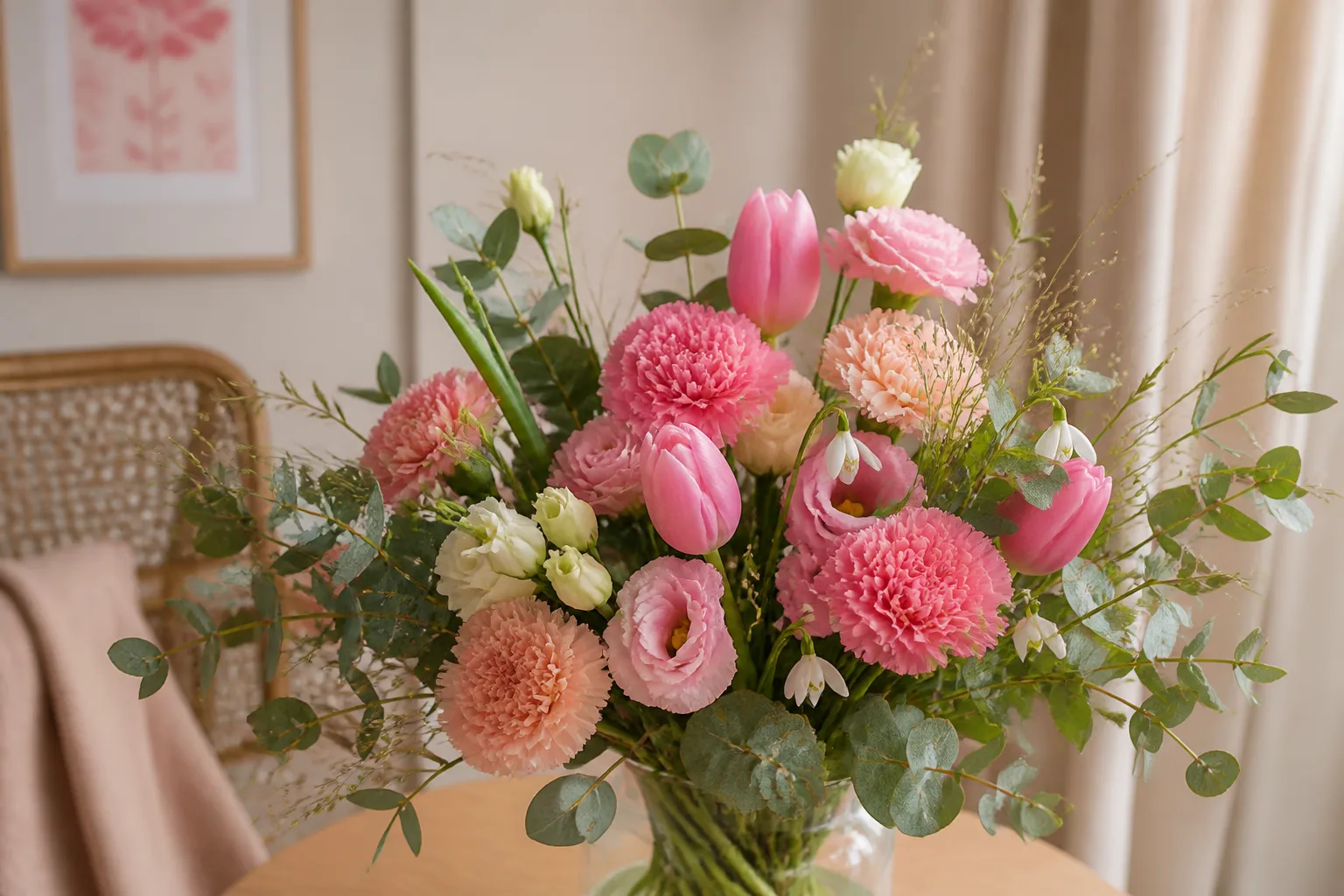
White and cream carnations with the first tulips and grasses.
In January, long-lasting blooms and clear colours work especially well. Carnations can be combined with tulips, ranunculus, lisianthus, wintry greenery and other seasonal flowers. Snowdrops, on the other hand, don't really belong in a delivered bouquet, as they are small, short-stemmed and wild populations are protected, but their symbolism can be picked up beautifully with white, delicate early bloomers and a light, airy bouquet structure. You can order your bouquet as a one-off bouquet or give a gift subscription starting in January.
January birth flower and the star signs Capricorn and Aquarius
If you were born between 22 December and 20 January, you are a Capricorn, often credited with discipline, reliability and perseverance. The carnation, which lasts three weeks in the vase, is its botanical counterpart. If you were born from 21 January onwards, you are an Aquarius, often associated with independence and originality, just like the snowdrop, which blooms before spring has even officially begun.
January birth flower as a tattoo
Both January flowers work well as a birth flower tattoo. The carnation, with its fringed petals, looks somewhat bolder, the snowdrop much more delicate. Popular choices are a fine-line style with a single carnation stem and carefully drawn fringes, often on the forearm, a minimalist snowdrop silhouette behind the ear or on the wrist, and a combination of both as a small January bouquet, with the month or an initial added. If you want to bring together several birthdays in the family, you can combine the January flowers with other birth flowers into a small floral design.